

Three Blue Dive Watches to Consider Before Buying an OMEGA Seamaster
Explore three blue dive watch alternatives to the OMEGA Seamaster: Panerai Submersible, Triton Subphotique and Oris Aquis Pro. Compare fit and features.
The circular slide rule is the feature that defines the Breitling Navitimer, but it is also the part that many owners never learn to use.
At first glance, the tightly packed numbers around the dial can look unnecessarily complicated. In reality, the Navitimer contains two logarithmic scales that work together as a mechanical calculator. Once you understand what the main markers represent, it can perform multiplication, division, speed, distance, time, fuel-consumption and unit-conversion calculations.
This guide explains how to use the Breitling Navitimer slide rule without assuming any previous experience.
The short answer is that the Navitimer uses a rotating outer scale and a fixed inner scale. You align two known values and then read the result elsewhere on the dial.
There are four main elements to recognise:
The unit index is used for multiplication and division. The hour index is used for calculations involving quantities per hour, including speed and fuel consumption.
The scales are logarithmic rather than linear. This allows multiplication and division to be performed mechanically, but it also means the watch does not position the decimal point for you.
A reading of 12 could represent 1.2, 12, 120 or 1,200. You must estimate the expected size of the answer yourself.

Breitling had already incorporated a circular slide rule into its Chronomat during the 1940s. In 1952, Willy Breitling adapted the principle specifically for aviation, combining it with a chronograph to create a wrist-worn flight computer.
In 1954, the Aircraft Owners and Pilots Association announced the Navitimer as its official timepiece. The model’s name combined “navigation” and “timer”, describing its original purpose directly.
Pilots could use the rotating scales to calculate average speed, distance, journey time, fuel consumption and conversions between statute miles, nautical miles and kilometres. These were useful calculations in an era before electronic cockpit instruments became commonplace.
Breitling describes the Navitimer as the first wristwatch flight computer and provides a detailed history of the collection in its official Navitimer archive.
Before attempting a calculation, identify which scale moves.
The outer scale rotates with the bezel. The inner scale remains fixed around the dial. Depending on the Navitimer reference and dial colour, these scales may use different colours, but the operating principle remains the same.
On most Navitimers, the fixed scale also includes several important markings:
The number 10 does not always mean ten. It can represent one, ten, one hundred or another multiple of ten, depending on the calculation.
This is the most important part of learning to use the slide rule. The watch gives you the significant figures, while common sense supplies the decimal point.

To demonstrate the basic process, we will multiply:
7 × 12 = 84
The same position can represent different multiples of ten. For example, the calculation could also represent:
The scale establishes the relationship between the numbers. You determine the appropriate decimal position.
Division uses the same scales in reverse.
For example:
120 ÷ 4 = 30
If the reading appears to be 3, 30 or 300, estimate the answer mentally. Since 120 divided by 4 must be somewhere close to 30, the correct interpretation is obvious.
The calculation method used here follows the archived Breitling Navitimer slide-rule instructions.
To calculate speed, you need to know the distance travelled and the time taken.
Suppose a journey covers 120 miles in 40 minutes:
120 miles ÷ 40 minutes = 180 mph
The MPH marker is more accurately considered an hour index. The same method can therefore calculate kilometres per hour or another quantity measured over an hour, provided the same unit is used throughout.
If you know the speed and distance, the Navitimer can calculate the expected journey time.
For example:
300 miles at 150 mph = 120 minutes
The scale may display this as 12, so you must recognise from the context that the journey cannot take 12 minutes.
The same bezel position can calculate distance when speed and time are known.
For example:
150 mph for 40 minutes = 100 miles
Once the speed has been aligned with the hour index, several different journey times and distances can be compared without moving the bezel again.
The hour index can be used for any quantity expressed per hour, not only speed.
Suppose an aircraft consumes 24 litres of fuel per hour and flies for 90 minutes:
24 litres per hour × 1.5 hours = 36 litres
The watch can also work backwards. If you know the total fuel used and the duration of the journey, the scales can calculate the average hourly consumption.
For real aviation, fuel planning must account for reserves, weather, routing and other operating requirements. The Navitimer should not be treated as the sole source for a safety-critical calculation.
The fixed scale includes markers for:
To convert 60 statute miles:
Because the bezel remains in position, you can read all three units without performing separate calculations.

Yes. The Navitimer is associated with aviation, but the two logarithmic scales can multiply or divide any compatible values.
It can be used to calculate:
It cannot directly add or subtract. Those operations are not supported by a conventional slide rule.
The Navitimer provides approximate rather than calculator-level results.
Accuracy depends on how precisely the scales are aligned and how carefully the markings are read. The graduations also become increasingly close together at higher values, making exact readings more difficult.
In practice, two or three significant figures are realistic. A result of 96.5 kilometres may be readable, while attempting to establish 96.56 kilometres would be unrealistic.
This is also why estimating the expected answer is important. The bezel will not warn you if you interpret 18 as 18 mph when the correct result should be 180 mph.
The operating method is fundamentally the same across the 41mm, 43mm and 46mm Navitimer B01 Chronograph models. The larger versions simply give the scales more physical space, which can improve legibility.
At MVS Watches, we have handled and photographed Navitimers across these different sizes, as well as earlier limited editions. The basic calculation process remains consistent, although the exact presentation and position of individual markings can vary between references.

Modern pilots have access to electronic flight computers, navigation systems and dedicated planning software. A mechanical wristwatch is no longer expected to carry the responsibility it did during the 1950s.
However, the slide rule remains completely functional. Learning to use it explains why the Navitimer looks the way it does and turns the bezel from a decorative detail into a genuine instrument.
For collectors, that connection between design and purpose is a significant part of the Navitimer’s appeal. Its busy dial was not created simply to look technical. Every scale and marker originally had a job.
You can learn more about the collection in our Breitling aviation guide or view our current selection of Breitling watches.
It performs multiplication, division, speed, distance, journey-time, fuel-consumption and unit-conversion calculations using a rotating outer scale and fixed inner scale.
The unit index is the red number 10 on the fixed inner scale. It is used as the reference point for multiplication and division.
No. The chronograph and slide rule are separate functions. The slide rule is operated by rotating the bezel and can be used while the chronograph is stopped.
No. A conventional logarithmic slide rule is designed primarily for multiplication, division, ratios and rate-based calculations.
It remains capable of performing genuine calculations, although electronic instruments are faster and more precise. For most owners today, its value lies in its functionality, history and connection with aviation.
Explore three blue dive watch alternatives to the OMEGA Seamaster: Panerai Submersible, Triton Subphotique and Oris Aquis Pro. Compare fit and features.

Original or newer OMEGA Apollo 8? Compare the 1869 and 3869 movements, lunar dials, rocket hand, dimensions and prices before choosing.

MVS Watches explains its finance option through Ideal4Finance, potential pre-owned savings and the costs to consider before financing a luxury watch.

The Breitling Navitimer’s circular slide rule is more than a design feature. This practical guide explains its scales and calculations step by step.
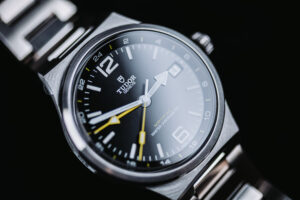
TUDOR celebrates its centenary in 2026 with a varied group of new watches. We look at four of the most significant releases so far, including the returning Northflag and the limited Black Bay Chrono “Carbon 26”.
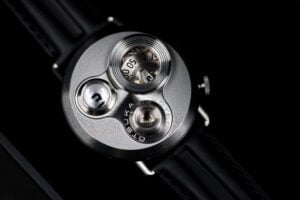
Discover Otsuka Lotec, founder Jiro Katayama and the No.7.5 jumping-hour watch, including its movement, 2023 updates and pre-owned buying advice.
You must be logged in to post a comment.