

Three Blue Dive Watches to Consider Before Buying an OMEGA Seamaster
Explore three blue dive watch alternatives to the OMEGA Seamaster: Panerai Submersible, Triton Subphotique and Oris Aquis Pro. Compare fit and features.
The newer OMEGA Speedmaster Apollo 8 improves the movement and adds an ingenious rocket-shaped seconds hand. We would still buy the original.
OMEGA’s updated Speedmaster Dark Side of the Moon Apollo 8 brings a more advanced movement, sharper lunar decoration and a Saturn V rocket circling its small-seconds subdial. It is an impressive revision of an already unusual watch.
Yet the earlier reference remains the one we would buy. Its appeal goes beyond being the cheaper option: we prefer its conventional seconds hand, luminous tachymeter scale and the way the lunar landscape remains the centre of attention.
We currently stock the original at MVS Watches, so we have an interest in this comparison. Here is our case for it, including the areas where the newer version is unquestionably stronger.
The original 311.92.44.30.01.001 arrived in 2018, marking the Apollo 8 mission’s 50th anniversary. OMEGA introduced its black-and-yellow successor, 310.92.44.50.01.001, in 2024.
| Detail | Original Apollo 8 | Newer Apollo 8 |
| Reference | 311.92.44.30.01.001 | 310.92.44.50.01.001 |
| Movement | Hand-wound Calibre 1869 | Hand-wound Co-Axial Calibre 3869 |
| Certification | Not Master Chronometer certified | METAS-approved Master Chronometer |
| Power reserve | 48 hours | 50 hours |
| Case | Black ceramic, 44.25mm | Black ceramic, 44.25mm |
| Thickness | 13.8mm | 13.0mm |
| Approximate total weight | 89g | 99g |
| Supplied strap | Perforated leather | Perforated rubber |
| Water resistance | 50 metres | 50 metres |
OMEGA’s published specifications. Weights include the supplied strap and fastening; they are not case-only measurements.
Those figures explain the technical changes. The reason to prefer one watch over the other starts with the dial.
The Apollo 8’s defining feature is its lunar landscape.
OMEGA laser-ablated the original’s blackened movement to represent the Moon’s surface. The skeletonised dial exposes the near-side interpretation, while the exhibition caseback reveals the far side. The decoration belongs to the movement itself, giving the design depth beyond a printed lunar motif.
That is what makes this watch interesting. Your eye moves between the hands, chronograph registers and textured surfaces underneath. Turn it over and the theme continues.
The yellow detailing gives all that darkness a point of contrast. It is a bold combination, but the colour palette is disciplined enough to hold the design together.
The newer version gives the Moon’s surface greater definition through revised engraving and contrasting finishes. We appreciate the additional detail. We simply do not think the original needed a more elaborate interpretation to succeed.
A replacement can be more finely executed without making its predecessor less desirable. With the Apollo 8, the original concept was strong enough to survive the update.
The newer watch’s Saturn V hand is clever. Made from Grade 5 titanium, it turns the small-seconds display at nine o’clock into a moving reference to the Apollo programme.
For a space enthusiast, that could be the deciding feature. It is distinctive, playful and far more ambitious than simply printing a rocket on the dial.
Our preference is for the original’s conventional seconds hand.
The lunar surface already gives this Speedmaster an extraordinary backdrop. A familiar hand lets that backdrop do the work, while the newer rocket introduces another feature competing for attention.
The original is hardly understated, but its treatment of the subject feels less literal. We like having the landscape to explore without a miniature spacecraft becoming the first thing we notice.
This is the most personal part of the comparison. If you love the rocket, the newer model offers something the original cannot. If you are indifferent to it, one of the successor’s main attractions disappears.
The movement upgrade deserves more credit than “two extra hours and a certificate”.
The Calibre 3869 adds a Co-Axial escapement, silicon balance spring and Master Chronometer certification approved by METAS. It also brings magnetic resistance rated to 15,000 gauss. These are meaningful engineering improvements.
For someone who wants the stronger technical specification, the newer Apollo 8 is the straightforward choice.
Power reserve is a smaller part of that story. The increase from 48 to 50 hours amounts to two additional hours of running time. Both watches remain manually wound, and an owner who winds theirs each morning is unlikely to change that routine.
The extra reserve is welcome. It is not a transformation in day-to-day convenience.
Our preference for the original does not depend on pretending its movement is superior. It depends on how much importance we place on the upgrade when choosing the complete watch.
A collector can value modern movement technology and still care more about the version of the dial they prefer looking at.
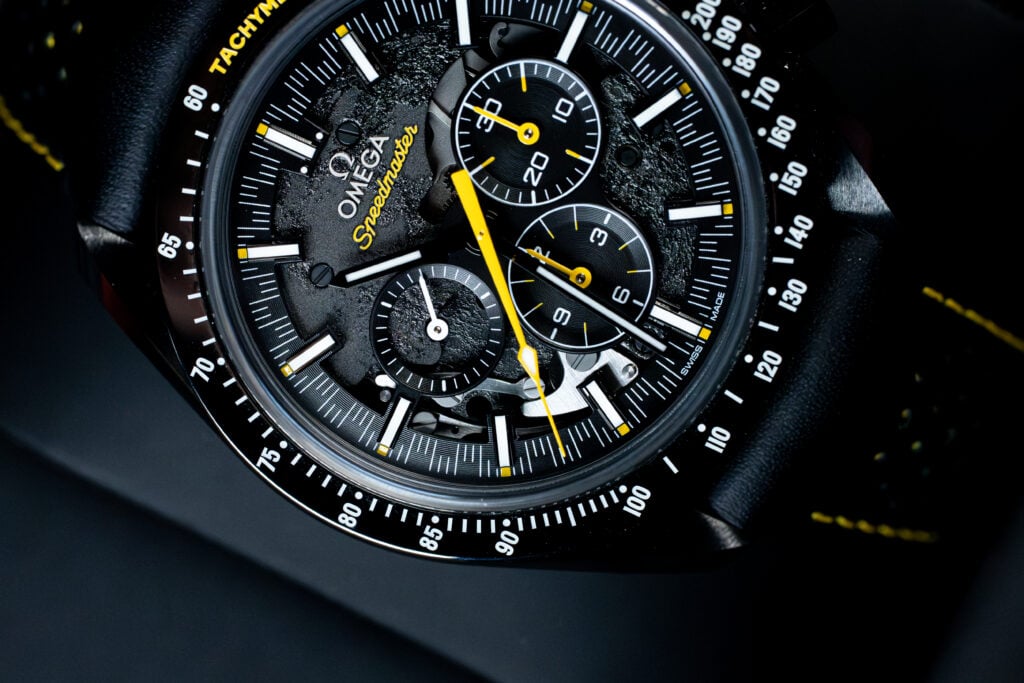
One change is easy to overlook in daytime photographs.
The original Apollo 8 has a Super-LumiNova tachymeter scale. The newer reference uses white Grand Feu enamel instead.
Enamel has its own appeal, but we would miss the original’s luminous scale. On a watch built around a dark lunar theme, that illuminated outer ring feels particularly appropriate.
It is also a useful reminder that an update can replace a feature rather than simply add to it. Buyers who enjoy the original’s low-light appearance have a specific reason to seek out the earlier reference.
Of all the differences between these two watches, this is one we would look at before deciding. Give the lume photograph as much attention as the photograph of the rocket.
The newer watch is thinner by 0.8mm. That is a worthwhile improvement, especially if case height is something you notice when wearing a chronograph.
The original has the lower published total weight, although the different straps and fastenings contribute to that comparison.
We would not award either watch a universal win for comfort. A thinner case does not tell the whole story, and neither does a lower weight. Strap fit and the shape of your wrist can matter more than either figure.
Both retain a substantial 44.25mm diameter. If size is your main concern, the newer version should not be mistaken for a smaller alternative.
The practical distinction is a slimmer profile versus a lighter supplied configuration. Which matters more is something to judge on the wrist.
UK retailer listings checked on 4 October 2026 advertised the original reference at £10,100 and the newer version at £13,500. That puts the advertised new-watch price difference at £3,400, approximately 34%. These are not their respective launch prices.
That premium buys real improvements. Our view is that they do not add enough to the experience we want from an Apollo 8.
We would rather have the original’s design and keep the difference.
Pre-owned purchases need a separate comparison. Look at actual asking prices for both generations, taking condition, completeness and warranty coverage into account. The newer model can also be available below its advertised new price, so a retail-versus-pre-owned comparison should not be presented as the universal saving between generations.
At the time of writing, our 2022 OMEGA Speedmaster Apollo 8 is listed at £6,995 with its original box and cards. That is the price of one specific pre-owned example, rather than a valuation of every original Apollo 8.
We would keep it.
For an existing owner, the question is whether the newer features solve something they find lacking. If magnetic resistance, Master Chronometer certification or the rocket hand are important enough, an upgrade has a clear purpose.
But if you already enjoy the original’s appearance and winding routine, the newer reference does not invalidate either. You can admire the engineering without needing to exchange your watch.
For a first-time buyer, we would start with the design. Decide which dial you prefer before comparing the prices. That avoids buying the cheaper watch while wishing it had a rocket, or paying more for technology you appreciate on paper but rarely think about afterwards.
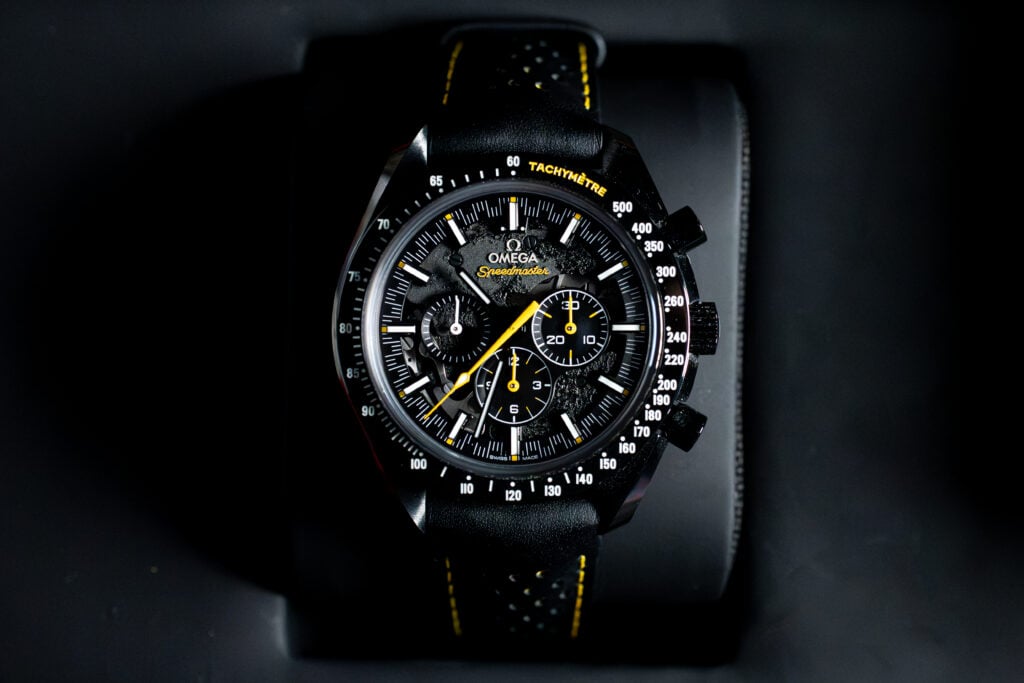
The original Apollo 8 gives us the version of this design we most want to own: a lunar landscape, yellow accents, conventional seconds hand and luminous tachymeter scale.
The newer model has the stronger movement specification and a slimmer case. It deserves those wins. But we prefer enough of the original’s details that its lower price feels like an additional advantage, rather than the only reason to choose it.
We would still pick the original if both were sitting in front of us. Knowing what each costs makes that decision easier.
View our current Speedmaster models, or browse our wider OMEGA collection.
Explore three blue dive watch alternatives to the OMEGA Seamaster: Panerai Submersible, Triton Subphotique and Oris Aquis Pro. Compare fit and features.

Original or newer OMEGA Apollo 8? Compare the 1869 and 3869 movements, lunar dials, rocket hand, dimensions and prices before choosing.

MVS Watches explains its finance option through Ideal4Finance, potential pre-owned savings and the costs to consider before financing a luxury watch.

The Breitling Navitimer’s circular slide rule is more than a design feature. This practical guide explains its scales and calculations step by step.
TUDOR celebrates its centenary in 2026 with a varied group of new watches. We look at four of the most significant releases so far, including the returning Northflag and the limited Black Bay Chrono “Carbon 26”.
Discover Otsuka Lotec, founder Jiro Katayama and the No.7.5 jumping-hour watch, including its movement, 2023 updates and pre-owned buying advice.
You must be logged in to post a comment.