

OMEGA Speedmaster Apollo 8 Old vs New: Why We’d Buy the Original
Original or newer OMEGA Apollo 8? Compare the 1869 and 3869 movements, lunar dials, rocket hand, dimensions and prices before choosing.
IWC Schaffhausen is difficult to define by a single watch.
The Pilot’s collection contains some of the brand’s most recognisable models. The Portugieser is far more traditional, while the Portofino moves towards the dress-watch end of the spectrum. Then there is the Ingenieur, which has brought IWC firmly back into the integrated-bracelet sports-watch conversation.
Having bought, inspected and sold IWC watches at MVS Watches, we’ve found that each collection attracts a slightly different buyer. Pilot’s Watches have probably been the most consistent sellers for us, but right now the Ingenieur is the part of IWC generating the most excitement.
The pre-owned market makes the brand particularly interesting. Many IWC references trade substantially below their original retail prices, while discontinued models provide access to watches that have disappeared from the current catalogue.
This guide explains the major collections, movements and technology worth understanding and what we would consider before buying one.
You can also view our current pre-owned IWC watches if you’re looking for watches physically available from MVS Watches.
IWC was founded in Schaffhausen in 1868 by American watchmaker Florentine Ariosto Jones. His idea was to combine modern manufacturing methods with established Swiss watchmaking expertise.
That engineering-led philosophy still makes sense when looking at IWC today.
The manufacturer has a long association with aviation watches, anti-magnetic engineering, diving watches and technical case materials. Even collections designed primarily around elegance tend to have a functional quality to them.
The five collections most pre-owned buyers are likely to encounter are:
Understanding the differences between them makes choosing an IWC much easier.
If there is one collection most people immediately associate with IWC, it is the Pilot’s Watch.
IWC introduced its first Special Pilot’s Watch in 1936. Legibility and functionality were central to the original design and remain obvious influences on the modern range.
In our experience at MVS Watches, Pilot’s Watches have been the most consistently popular IWC models.
The collection itself is broad.
The Mark series is arguably one of the easiest entry points into IWC.
Watches such as the current Mark XX retain the clear aviation-inspired dial without the substantial dimensions associated with something like the Big Pilot.
The modern Mark XX also demonstrates how the technical specification has progressed. Its IWC-manufactured calibre 32111 provides approximately 120 hours of power reserve.
For someone wanting an IWC that can comfortably work as an everyday watch, the Mark series makes a lot of sense.
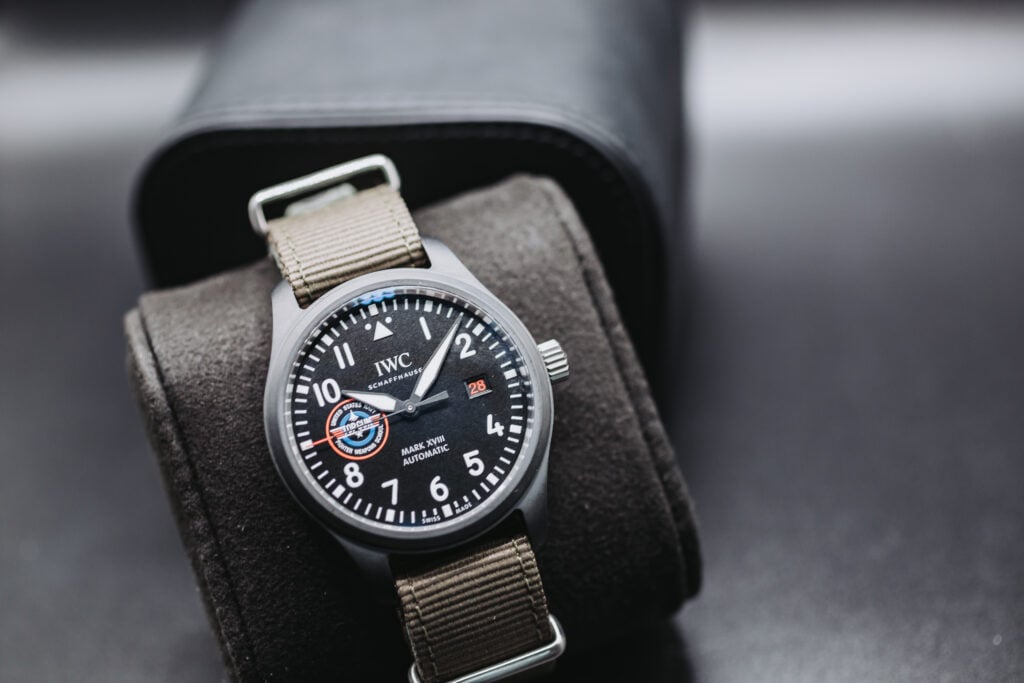
The Pilot’s Chronograph adds more wrist presence and considerably more dial activity.
There have been numerous generations, movements and special editions, including watches connected with the Spitfire and TOP GUN ranges.
This variety makes the pre-owned market particularly interesting. Two Pilot’s Chronographs that initially look similar can differ in movement, case dimensions and materials, so knowing the reference matters.
The Big Pilot takes IWC’s aviation design to its logical extreme.
The oversized case and prominent crown are intentional parts of the watch’s identity. It isn’t designed to disappear underneath a cuff.
Size is therefore particularly important when considering one pre-owned. Diameter tells only part of the story because case thickness, lug shape and strap configuration all affect how the watch actually feels on the wrist.
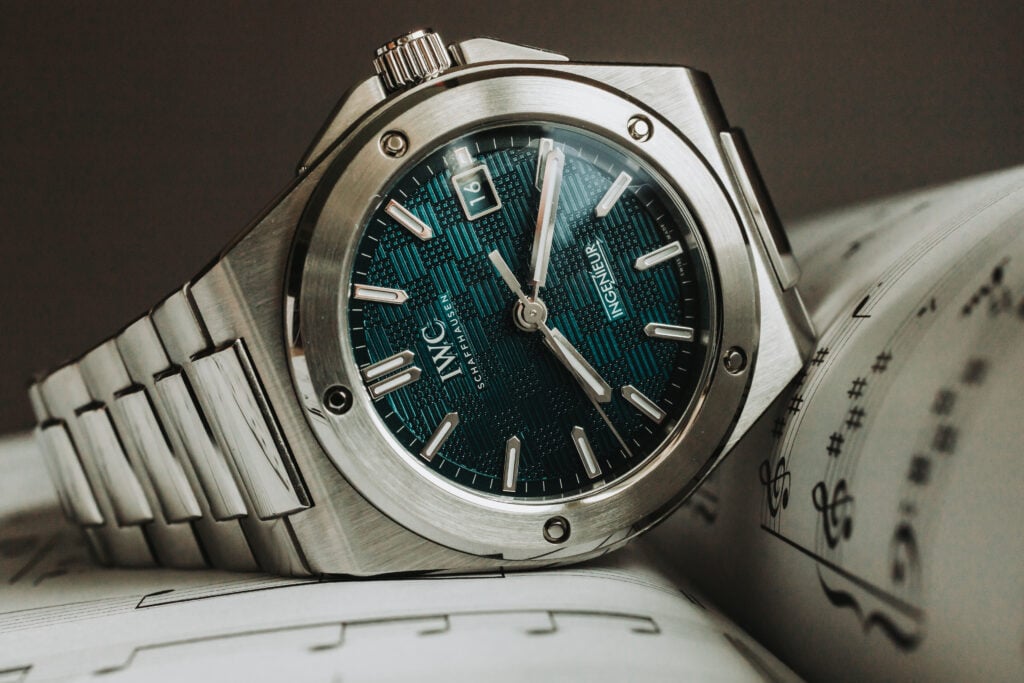
The Ingenieur is currently one of the most interesting parts of IWC.
The collection was originally introduced in 1955, but the design most enthusiasts associate with the name came later. During the 1970s, Gérald Genta created the Ingenieur SL Reference 1832, bringing the integrated-bracelet sports-watch approach associated with his work to IWC.
In 2023, IWC returned to that design language with the Ingenieur Automatic 40.
We’ve handled the Aqua-dial Ingenieur Automatic 40 at MVS Watches and it is one of the standout modern IWCs we’ve had through our hands.
The proportions work.
Its 40mm stainless-steel case has plenty of presence, but the integrated bracelet and redesigned ergonomics prevent it from simply feeling like another large sports watch. The combination of polished and satin-finished surfaces is particularly effective across the case and bracelet.
Then there is the Aqua dial. Its colour combined with the characteristic grid texture gives the watch considerably more personality in person than the specification sheet suggests.
Inside is IWC’s calibre 32111, an automatic manufacture movement with a 120-hour power reserve. The watch also offers 10-bar water resistance and uses a soft-iron inner case to help protect the movement from magnetic fields.
For us, however, the real appeal is simpler: it feels extremely well put together.
IWC has now expanded the modern Ingenieur into 35mm, which gives the design a very different character.
In July 2026, the company added the Ingenieur Automatic 35 IW324902 with a new Pool-coloured dial.
At 35.1mm and 9.4mm thick, it reflects the renewed interest we’re seeing across the watch market in more compact proportions. It retains the integrated bracelet, five functional bezel screws and grid-pattern dial associated with the larger Ingenieur.
The Pool reference is particularly timely because it shows IWC actively developing the Ingenieur rather than simply relying on Gérald Genta’s historical connection.
IWC officially introduced the Pool Ingenieur Automatic 35 in July 2026.
The Portugieser represents a completely different side of IWC.
Its origins date to 1939, when Portuguese importers requested wristwatches offering the precision associated with marine chronometers. IWC responded by putting high-precision pocket-watch movements into large wristwatch cases.
Those origins explain much of the Portugieser’s appearance today.
Large, open dials, relatively narrow bezels and clear Arabic numerals give the watches considerable presence without relying on the styling of a conventional sports watch.
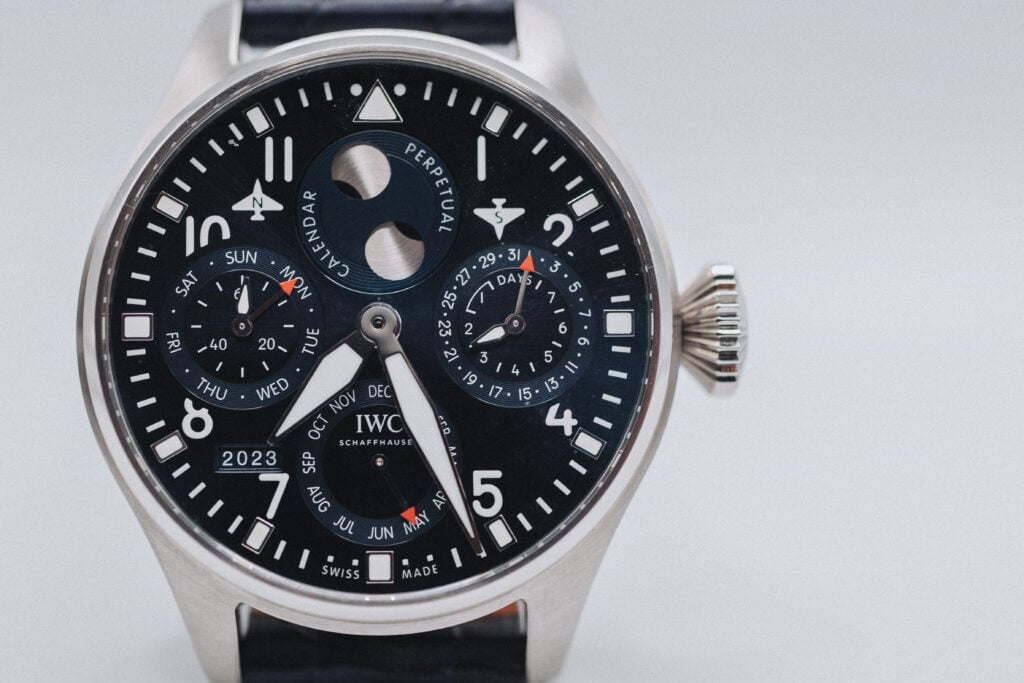
The Portugieser Chronograph is probably one of the best-known modern examples, but the collection extends through automatic watches, perpetual calendars and other complications.
For a buyer who appreciates IWC’s watchmaking but doesn’t want the aviation styling of a Pilot’s Watch or the integrated bracelet of an Ingenieur, the Portugieser is an obvious alternative.
The Portofino sits at the more traditional end of IWC’s catalogue.
Introduced as a collection in 1984, it generally uses cleaner cases and less instrument-like dial designs than the Pilot’s Watch or Ingenieur.
There has been considerable variety over the years, including automatic, manually wound, chronograph and moonphase references.
That variety makes the Portofino interesting pre-owned, particularly because it doesn’t currently receive the same level of attention as the Ingenieur.
For someone who wants IWC quality in a more understated watch, that lack of hype can actually be useful.
The Aquatimer is sometimes overlooked when discussing IWC.
That’s surprising given that the collection has genuine history. IWC introduced its first Aquatimer in 1967, using an internal rotating diving bezel operated through a second crown.
Later generations have evolved substantially.
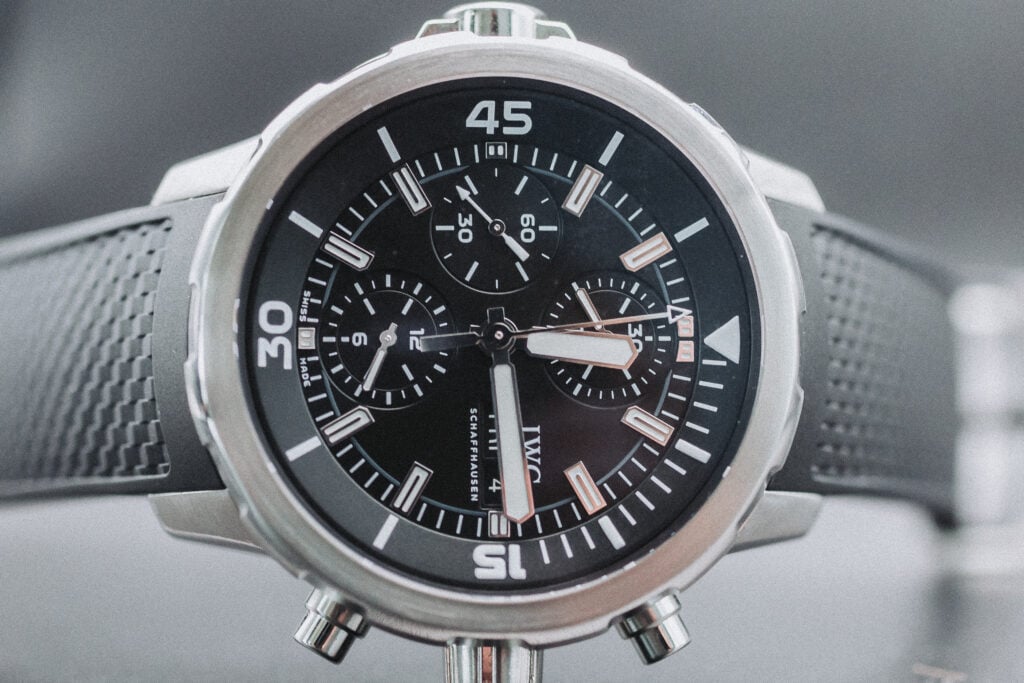
Bezels, movements, case sizes, water-resistance ratings and materials vary considerably across different Aquatimer references.
For pre-owned buyers, that’s part of the appeal. Older Aquatimers can provide something quite different from the usual luxury dive-watch choices while retaining an established connection to IWC’s engineering history.
The question of whether IWC uses “in-house movements” isn’t best answered with a simple yes or no.
Modern IWC has numerous manufacture calibre families. Its historical catalogue also contains plenty of watches using movements based on externally supplied architecture.
That doesn’t automatically make one watch better than another.
What matters when buying pre-owned is understanding what is inside the particular reference you’re considering.
For example, the calibre 32111 used in watches including the Mark XX and Ingenieur Automatic 40 is an IWC-manufactured automatic movement offering approximately five days of power reserve.
Other IWC manufacture movement families include the 52000 and 82000 series.
One of IWC’s best-known technical developments is the automatic winding system created by former technical director Albert Pellaton.
The system uses movement of the rotor in both directions to wind the mainspring efficiently.
Modern versions used in movements such as the 52000 and 82000 families employ ceramic components in areas exposed to significant wear.
It is a good example of IWC continuing to develop an engineering idea from its past rather than simply retaining the name for historical value.
Not every modern IWC calibre uses the Pellaton system, so again it is worth checking the specifications of the particular watch.
IWC’s engineering approach extends beyond its movements.
In 1980, the company introduced the Porsche Design Titanium Chronograph, an important milestone in the use of titanium for watch cases.
Ceramic subsequently became another important IWC material, particularly within more technically styled watches.
More recently the manufacturer developed Ceratanium, a material based on a specially formulated titanium alloy which undergoes a heat treatment that gives its surface ceramic-like properties.
You’ll encounter these less conventional materials particularly within Pilot’s and TOP GUN references.
For a pre-owned buyer, material affects much more than appearance. It can significantly change the weight and feel of a watch on the wrist as well as how the case shows wear.
This is where we think IWC gets particularly interesting.
Very few IWC references maintain values close to their original RRP once they reach the pre-owned market.
If you’re buying new and planning to sell again quickly, that’s something worth understanding.
For the second owner, the same depreciation can present an opportunity.
Watches that were difficult to justify at full retail can become significantly more attractive when pre-owned, particularly when you’re comparing the quality of the case, movement and finishing against other watches available at the same price.
Discontinued references take that further.
Previous-generation Pilot’s Watches, older Portugiesers, Aquatimers and limited editions mean the pre-owned IWC market extends considerably beyond the watches shown in the manufacturer’s current catalogue.
We wouldn’t buy any IWC because we expected it to increase in value. We’d buy the reference we actually wanted, at a price that reflects the pre-owned market.
If you’re new to the secondary market, our guide to buying pre-owned luxury watches in the UK covers condition, authentication and what to check before purchasing.
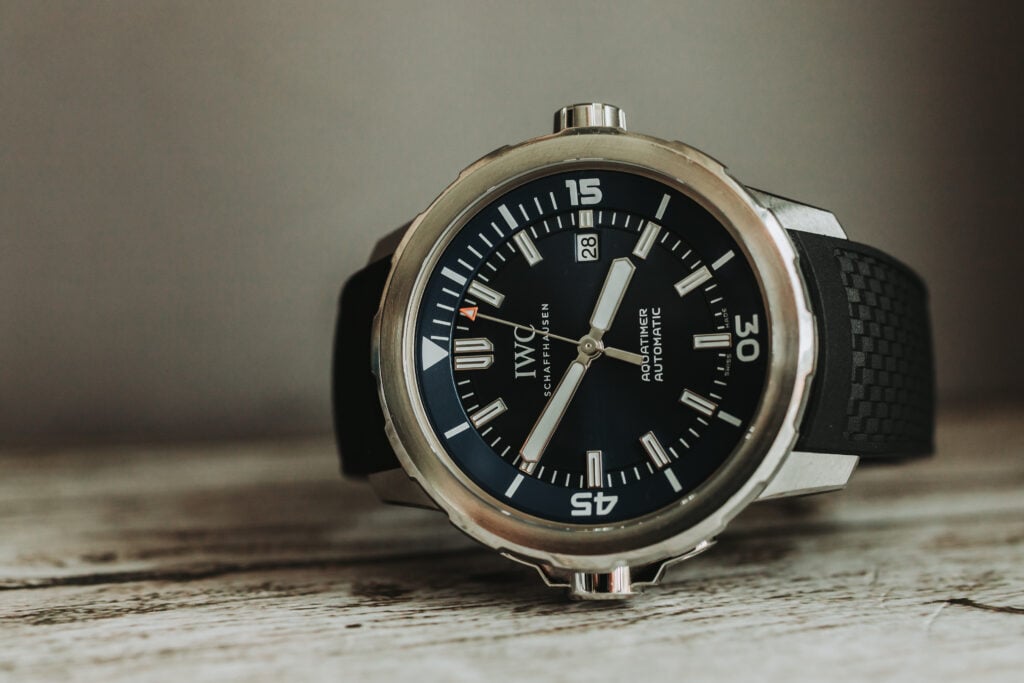
When an IWC comes into MVS Watches, we start with the individual reference.
The case, dial, hands, crown, movement where required, bracelet or strap and identifying markings should correspond with the expected configuration of that watch.
Condition also needs to be considered properly.
Previous polishing isn’t automatically an issue, but excessive refinishing can alter case geometry and remove some of the contrast between polished and brushed surfaces.
That becomes particularly relevant on watches such as the Ingenieur, where the finishing of the integrated bracelet and case is a major part of the design.
We also assess the watch’s operation, functions and timekeeping and check any accompanying box, papers and service documentation.
Paperwork is useful when present, but it isn’t a substitute for inspecting the actual watch. We explain our approach in more detail in our luxury watch authentication guide.
IWC is much broader than its reputation for Pilot’s Watches initially suggests.
The Pilot’s range remains one of the safest places to start, while the modern Ingenieur has brought renewed attention to a collection with genuine Gérald Genta design heritage. The Portugieser provides something more traditional, the Portofino offers understatement and the Aquatimer gives buyers a less obvious route into a serious dive watch.
For us, the attraction of IWC is the combination of engineering, distinctive collections and the opportunities available on the pre-owned market.
There are some very good watches hiding behind retail prices that the secondary market simply doesn’t sustain.
Explore the pre-owned IWC watches currently available at MVS Watches.
IWC is an established Swiss manufacturer with a long history of producing aviation, sports and complicated mechanical watches. It is particularly associated with functional design, mechanical engineering and collections including the Pilot’s Watch, Ingenieur and Portugieser.
Pilot’s Watches are among the models most closely associated with IWC and have been consistently popular in our experience at MVS Watches. The Ingenieur is currently attracting considerable attention following the return of the Genta-inspired design and expansion of the modern collection.
Gérald Genta designed the Ingenieur SL Reference 1832 during the 1970s. The modern Ingenieur collection draws heavily on the aesthetic codes of Genta’s design while using contemporary cases, bracelets and movements.
Many IWC watches trade below their original retail prices on the pre-owned market. Values vary according to reference, condition, rarity and demand, so buyers should not assume an IWC will retain or increase in value. The resulting depreciation can, however, make pre-owned examples particularly attractive.
Buying pre-owned can provide substantial savings against original retail pricing and access to discontinued references that are no longer part of IWC’s current catalogue. Authenticity, condition, specification and price should all be considered when comparing individual watches.
Original or newer OMEGA Apollo 8? Compare the 1869 and 3869 movements, lunar dials, rocket hand, dimensions and prices before choosing.

MVS Watches explains its finance option through Ideal4Finance, potential pre-owned savings and the costs to consider before financing a luxury watch.

The Breitling Navitimer’s circular slide rule is more than a design feature. This practical guide explains its scales and calculations step by step.
TUDOR celebrates its centenary in 2026 with a varied group of new watches. We look at four of the most significant releases so far, including the returning Northflag and the limited Black Bay Chrono “Carbon 26”.
Discover Otsuka Lotec, founder Jiro Katayama and the No.7.5 jumping-hour watch, including its movement, 2023 updates and pre-owned buying advice.

Our guide to IWC watches covers the Pilot’s, Ingenieur, Portugieser, Portofino and Aquatimer, movements, sizing and buying pre-owned.
You must be logged in to post a comment.