
Atelier Wen and the Man Who Built His Own Rose Engines
How Master Cheng taught himself guilloché, built his own rose engines in a cave near Xinmi, and cut the dial of the Atelier Wen Perception.
Master Cheng, the guilloché dial of the Perception, and the story the video doesn’t have time for.
In a cave on a mountain near Xinmi, in China’s Henan province, a former machinist spent a year building a machine. It didn’t work. He built two more. Neither worked either.
The machine was a rose engine, the tool used to cut guilloché patterns into metal. The man was Cheng Yucai. His fourth attempt, finished in 2018, was the first to cut the pattern he was after. Today his hand-turned dials sit at the centre of the Atelier Wen Perception, a watch we’ve had through MVS in both its first and second generations.
Our video shows you the watch on the wrist and under the light. This post goes the other way: into the machine, the workshop and the person behind the dial. Watch the video first if you haven’t, then come back.
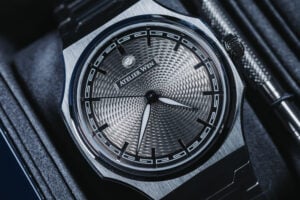
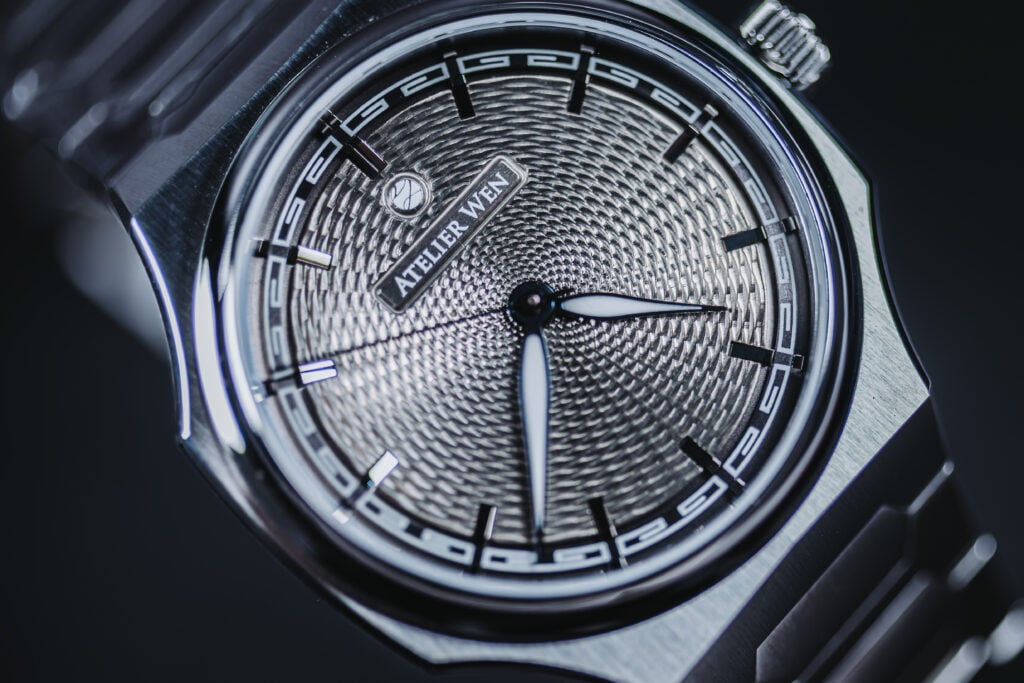
Guilloché, also called engine turning, is a pattern cut mechanically into a metal blank. Atelier Wen describes the result as alternating raised and recessed areas, which is why the dial changes from every angle: each ridge and groove gains or loses light as the watch moves.
Two machines do the work. A rose engine cuts circular and curving patterns, and takes its name from the rosettes, the cam-like guides that steer the workpiece. A straight-line engine cuts straight and geometric ones. Neither is automatic the way a CNC mill is. The craftsperson turns a handle with one hand to drive the spindle slowly, while the other hand brings the cutting tool to the dial. Attention drifts, the line shows it.
The technique is older than watchmaking. Engine-turning lathes were used on wood and soft materials for centuries before anyone put one to a dial. Abraham-Louis Breguet is credited with bringing guilloché to watch dials, with sources dating it to 1786. It then fell out of fashion for a long stretch, and today the people who still do it are few. Monochrome estimates there are probably fewer than 100 craftspeople practising traditional guillochage in Switzerland. Breguet and Patek Philippe run their own ateliers. Independent dial makers such as Metalem and Comblémine supply the rest.
One point matters if you’re buying: hand-turned guilloché carries small variations in line depth and spacing. That is the signature of the process, not a defect, and it is the visible difference from a stamped pattern.
Everything below comes from Atelier Wen’s own 2022 profile of Cheng, written by co-founder Wilfried Buiron. It is the brand’s account, and we’ve treated it that way.
Cheng was born into a poor rural family and left school around fourteen. He moved to Beijing for short factory jobs, then took apprenticeships, including one in a precision-instrument department of the army. By about thirty he had a well-paid machinery job, a wife and children.
In 2014, over lunch, an acquaintance showed him an antique Russian tobacco box with a wavy radial guilloché pattern under blue enamel. The acquaintance told him nobody in China practised the craft. Cheng was thirty-five. He set aside about RMB 350,000 (roughly US$55,000 by the brand’s conversion), nearly all his savings, and left his job.
He moved to Xinmi, a city of around 800,000 people about 700 km from Beijing, and set up a workshop in a cave on a nearby mountain, chosen for the lack of distractions and vibration. A cutter that has to place one groove exactly beside the last has no use for a shaking floor, which is the logic behind the cave. His friends and his wife thought he was mad. He expected to earn nothing until about thirty-eight.

Buiron describes Cheng building that first engine “never having seen one such machine by himself”, so the design was his own. There are two different fours in this story. The first working rose engine was his fourth attempt. By 2021 he had built seven machines in total, and four of them worked.
| Year | What happened |
| 2014 to 2015 | Builds his first rose engine by hand, to his own design. About a year, 16-hour days, seven days a week. It doesn’t work. |
| 2016 | Builds two more. Both are unusable. |
| 2018 | Completes his first working machine. About 90% of the components are handmade. A journalist’s article (by Liu Xingli) brings him attention. |
| 2021 | Completes his seventh machine, the fourth working one. |
| 2022 | The Perception launches, described by Atelier Wen as the first locally made watch to use his work. |
| April 2024 | First trip outside China, to Geneva. |
Per Atelier Wen, his current set is rose engines and straight-line engines, and together the four working machines cut more than 1,000 patterns.
Atelier Wen’s 2022 profile puts a dial at about eight hours on the rose engine. Time and Watches describes the process as entirely manual, needing several hours of uninterrupted work per dial. In the video we point out the square pattern running around the minute track against the curves in the centre. A straight-line engine is the tool for straight geometric work, but we haven’t found Atelier Wen stating which machine cuts which part, so we won’t assume.
According to Atelier Wen’s account, after the 2018 article Cheng began receiving orders through Beijing-based middlemen, with the finished dials sent to Switzerland. The brand says Swiss brands present those dials as their own and Cheng isn’t credited. We can’t verify who the buyers are, and the brand doesn’t name them. What it does help explain is why Atelier Wen built so much of the Perception’s story around him.
Cheng has said he has no interest in making his own brand or complete watches. As of March 2022 he named two goals: to reach the level of Swiss dial makers Comblémine and Metalem, and to popularise guilloché in China while giving young people from hard backgrounds a way in. He had four apprentices then, one of three years’ standing, planned to take no more than ten in total, and taught machinery at a nearby school every Monday, where he found them.
Atelier Wen began in April 2017 with two French friends, then both 22 and finishing degrees at the University of Warwick. The founders’ story is that Robin, a collector since fourteen with time at the French Chamber of Watchmaking in Shanghai and a year at Peking University in 2016, saw good watches being made in China while buyers still judged quality by labels such as Swiss Made. Wilfried Buiron, born in Hong Kong, a Peking and Tsinghua graduate, brought the Chinese craft side. Their first series was the porcelain-dial Ji. The Perception, with Cheng’s dial, was the second collection.
The movement in the first Perceptions came from Dandong in Liaoning province. Atelier Wen’s Inside the Atelier series visits Liaoning Peacock Watch Company there, which it credits as the team behind the Perception’s mechanical movement.
In April 2024 Atelier Wen took Cheng to Geneva for its first appearance at the city’s annual watch gathering, presenting his work at the Beau Rivage hotel. It was his first time outside mainland China and the first time he’d met other guillocheurs outside his own workshop. What surprised him, according to the third Inside the Atelier film, was how many people already knew who he was.
One detail worth noting. In 2022 Cheng named Comblémine as a benchmark. Comblémine is the dial company of Kari Voutilainen, and Voutilainen is on the list of people Atelier Wen thanks in the Geneva film. The credits don’t say what passed between them, so that is as far as we’ll take it.
The hand-turned dial stays constant across the Perception’s generations. What changes is what’s behind it.
| First and second generation | Third generation (V3) | |
| Seen at MVS | Ying (smoky grey, blue hands), Xia (salmon) | Not yet |
| Movement | Automatic made by Dandong/Peacock in China, reported at 41 hours of power reserve | Customised Pequignet EPM03, a French calibre from Morteau |
| Caseback | Partial window; on our pieces the lion’s open mouth frames the movement and blue rotor | Full sapphire display |
| Seconds | Reported without hacking | First Perception with hacking seconds |
| Price | n/a, pre-owned | US$4,850 at launch in May 2026, not limited |
Is Atelier Wen a Swiss brand? No. It was founded by two French friends, has its registered office in Hong Kong, and the Perception is made in China. The V3 now uses a French movement.
Is the dial really hand-made? Per Atelier Wen, Master Cheng cuts it by hand on rose engines at his workshop near Xinmi, at about eight hours a dial. That is the brand’s account, and it is consistent across its own pages and the press coverage we’ve read.
Is Cheng really China’s only guilloché master? Atelier Wen’s journal calls him China’s and Asia’s only one. That is a brand claim we haven’t been able to verify independently, so we describe him as the guillocheur behind the dial and let the brand make that claim itself.
Ying or Xia? In the video we split it this way: on the Xia your eye goes to the colour, on the Ying it goes to the blue hands first and then to how much is happening behind them.
Watch the video above if you haven’t, and subscribe for more watch content. If you’re after Atelier Wen or other independent and international brands, see our international luxury watches collection and microbrand collection.
Sources
How Master Cheng taught himself guilloché, built his own rose engines in a cave near Xinmi, and cut the dial of the Atelier Wen Perception.

Explore five unusual watches with MVS Watches, from Louis Erard’s moving monster face to Mr Jones’s giant spider, AWAKE’s aliens and Spinnaker’s luminous ghosts.

Explore three blue dive watch alternatives to the OMEGA Seamaster: Panerai Submersible, Triton Subphotique and Oris Aquis Pro. Compare fit and features.

Original or newer OMEGA Apollo 8? Compare the 1869 and 3869 movements, lunar dials, rocket hand, dimensions and prices before choosing.

MVS Watches explains its finance option through Ideal4Finance, potential pre-owned savings and the costs to consider before financing a luxury watch.

The Breitling Navitimer’s circular slide rule is more than a design feature. This practical guide explains its scales and calculations step by step.
You must be logged in to post a comment.